Posts

How to Check the Quality of TMT Bars?

Image
  TMT or Thermo-Mechanically Treated bars are extensively used in construction projects due to their high tensile strength, durability, weldability, ductility, corrosion resistance, fire resistance, earthquake resistance, etc. properties. These Bars are the backbone of any sturdy structure and ensuring the quality of the TMT bar is crucial for the safety and longevity of your construction project. Here are a few points to verify the quality of TMT Bars while choosing the top-notch TMT bar before you buy them. 1. Brand and Certification: Choose TMT bars from reputable manufacturers that adhere to established quality standards, such as IS 1786:2008 marks, ISO 9001:2015 certification, etc. Reputed brands like Rajuri Steel are more likely to stick to stringent quality standards. Whenever you buy any TMT bar look for certifications and labels on the bars that confirm their compliance with these standards. 2. Physical Inspection: Visual examination can indicate a lot about the quality o...

Building Enduring Landmarks With Ribbed TMT Bars

Image
When it comes to construction, durability and longevity are paramount. As architects, engineers, builders, and other construction professionals strive to leave their mark on the world, one key element plays a crucial role in ensuring that their creations stand the test of time i.e. high-quality TMT bars. These reinforced steel bars with their distinctive ribbed pattern, have revolutionized the construction industry by providing unparalleled strength and resilience to structures. What Are Ribbed TMT Bars TMT bars, which are also known as Thermo-Mechanically Treated bars, are steel bars that have undergone a specialized manufacturing process to enhance their properties. This process involves the application of heat and mechanical treatment, resulting in a unique combination of strength and ductility. The distinguishing feature of ribbed TMT bars is their ribbed pattern, which enhances their bonding with concrete. This improves the overall structural integrity of the building.   Benef...

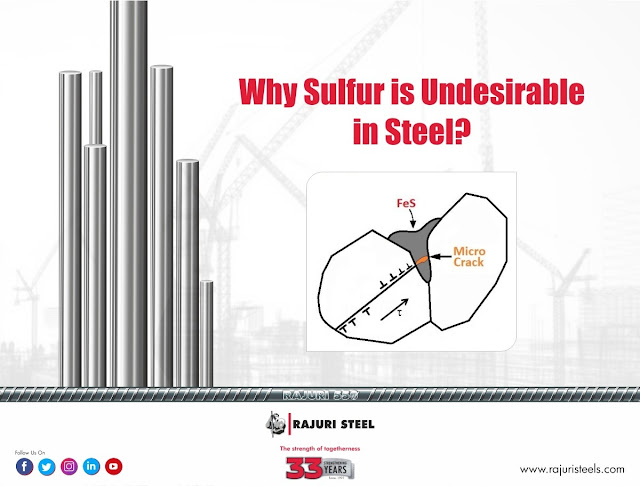
Why Sulfur is Undesirable in Steel?

Image
Steel is one of the world’s most used materials, made from a combination of iron and carbon, and various other elements. From the smallest construction to the most complex structures, it is everywhere surrounding and impacting us daily. As it plays such a vital role, knowledge about this material is pretty uncommon.  What is Steel? Steel has played a vital role in the development of modern civilization and is not to be confused with iron. In the simplest form, Steel is iron ore alloyed with less than 2% carbon. However, many other elements like Chromium, Aluminum, Manganese, Iron, Phosphorus, Sulfur, Copper, Nickel, etc. can also be added to produce several grades of steel alloys with different properties. Steel has many advantages in the construction industry, which include many parameters like tensile strength, compressive strength, yield strength, ultimate strength, fatigue strength, elongation, ductility, low weight, hardness, resistance to corrosion, resistance to fire, etc....

Leading Towards a More Promising Future with Better and Stronger Capabilities

Image
  With our vision to be a premium business conglomerate and provide the best and the most efficient steel products, we have employed more promising technologies that entrust us to meet the highest global benchmarks in products. Rajuri Steel, one of the leading manufacturers of TMT bars, has spanned over 25 acres of technologically advanced plant in Jalna, which will be pivotal for our growth in the country and better customer satisfaction. This ambitious facility is inaugurated on 28th April 2023 at Jalna, Maharashtra, by Smt. Ruchika Chaudhry Govil, Additional Secretary, Ministry of Steel and Hon’ble MP Raosaheb Patil Danve, Union Minister of State for Railways, Coal and Mines. Are also graced by the presence of Mr. Subhash Kumar (Joint Secretary, Ministry of Steel), Mr. R. P. Gupta (Director, Ministry of Mines), Dr. Anupam Agnihotri and Mr. R. N. Chouhan (JNARDDC), and many other prominent personalities. The premium quality plant has a production capacity of 75000MTPM. Plant enjo...

Scrap The Waste: Recycling Steel For A Robust Future

Image
  Climate change has been a hot global topic for the past few years, calling to attention the need for policies and actions that will reverse and prevent environmental damage. Resource efficiency, recycling, and a circular economy have become the catchphrases for achieving sustainable development that will halt climate change.  Steel scrap and sustainability Steel is one of the world's most recyclable materials; it can be used and reused an infinite number of times. Steel scrap is obtained from steelworks, old vehicle bodies, ship containers, buildings, and a host of consumer items. Although most steel in the world is produced using iron ore as the primary raw material, steel scrap is increasingly being used as the secondary raw material for steel production using the EAF method.  Steel scrap recycling is cheaper, and producing steel with scrap reduces water and energy consumption and greenhouse gas emission by big margins, compared to the traditional method. It is estima...

TRUE AS STEEL: A New Paradigm For Safety and Health In The Steel Industry

Image
  “Nothing is more important than the safety and health of people who work in the steel industry.”    - World Steel Association  Steel  is ubiquitous in our lives. From kitchen utensils to buildings and a lot of things in between, no aspect of our life remains untouched by steel.  There was a time when making steel was considered so dangerous that accidents were seen as part of the process! Today, it is highly mechanized and automated, eliminating most hazards of the past. The steel industry employs over 6 million people globally*. Data collected over the past decades shows that the steel industry’s safety record has improved steadily over the years. According to the World Steel Association, the injury rate per million hours worked decreased by 82.3% over the past 15 years (2006-2020). Although the figures are promising, steel industry workers still get routinely injured and alarming accidents happen every year since safety conditions vary widely in plants ...

Industry 4.0: Transformer of The Steel Industry

Image
  Industry 4.0 refers to the latest industrial revolution that follows three earlier ones. The first industrial revolution happened in the mid-18th century till about 1830 and marked the shift from hand production to steam-based machinery. The second occurred between 1870 and 1914 with the birth of electricity and the telegraph. The third was brought about by information and computer technology in the 20 th century. How does Industry 4.0 work? Industry 4.0 is based on cutting-edge technologies that enable digital transformation. Artificial Intelligence (AI) , Machine Learning (ML), and the  Internet of Things (IoT) form the core of Industry 4.0. Digitalization is a pre-condition for Industry 4.0, but Industry 4.0 is much more than digitalization! IoT sensors placed on machines and other equipment monitor performance in real-time and send vast amounts of data to ML models, which analyze big data and fine patterns in operation to learn how the system works. The ML model send...

TOTAL QUALITY: A Long-term Success Strategy

Image
  What is Quality?  “A measure of excellence or a state of being free from defects, deficiencies, and significant variations. Quality is brought about by strict and consistent commitment to certain standards that achieve uniformity of a product, service, or process in order to satisfy specific customer or user requirements.”  Total Quality Management (TQM) is not a one-time operation or an occasional practice. It is a regular and ongoing process in which errors in production or manufacturing, supply chain, and customer service or experience are detected to reduce or eliminate them. It involves all employees, not just the top management, and integrates quality improvement into the organization using data, systems, processes, strategies, and communication.  Advantages of TQM Fewer defects: TQM ensures that products and services are created error-free in the first place. This naturally reduces product defects and the need for recalls, fixes, or customer support. Reduc...

All About Low-Carbon Steel

Image
  Since the industrial revolution, iron and steel production has been powered by coal. This is now changing, and the steel sector is evolving to supply goods and services in a future in which the emission of carbon dioxide and other greenhouse gases is drastically reduced. Low-carbon steel is the form of carbon steel that is most frequently utilized and these steels usually include less than 0.25 percent carbon. It cannot be made Martensitic by heating it; instead, cold practice is used to harden the material. Carbon-based are often delicate and low-obstructive. Eventually, they do have a great degree of flexibility, which is fantastic for ease of machining, welding, and other processes. In order to make specialized building materials, barrels, frames, furnaces, and farm equipment, low carbon steel is normally not heat treated before use and is instead rolled into steel edges, channel steel, I-beams, sheets, strips, or plates. For deep-drawn goods like automobile cabs and engine co...

The Steel Industry May Expand Sustainably While Preserving Nature

Image
  Steel is one of the most environmentally friendly materials available, yet decarbonizing it is still difficult. The energy transformation as well as other worldwide sustainability initiatives depend on steel for continuing economic growth. However, the steel industry is also among the most energy-intensive in the world, producing around 8% of all carbon dioxide emissions.  As the global decarbonization drive picks up speed, lowering these emissions is crucial for steelmakers. Steelmakers who act now to enhance the sustainability of operations can benefit from environmental, social, and governance (ESG) indicators to gain a competitive advantage and stay ahead of changing carbon restrictions. By 2050, the global steel sector is anticipated to be responsible for around 35% of emissions brought on by fossil fuels. The industry is pushing harder to switch to the best decarbonization methods currently available. To hasten this shift, Rajuri Steel is aiming to scale up and early a...